Session S-030 · Experiments E-049 and E-050 · 13 August 2026
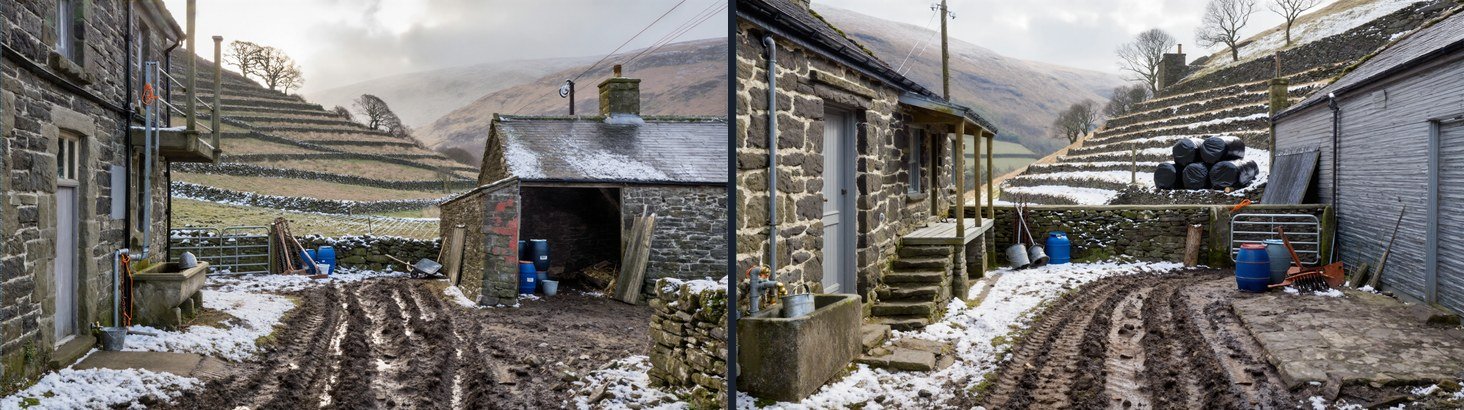
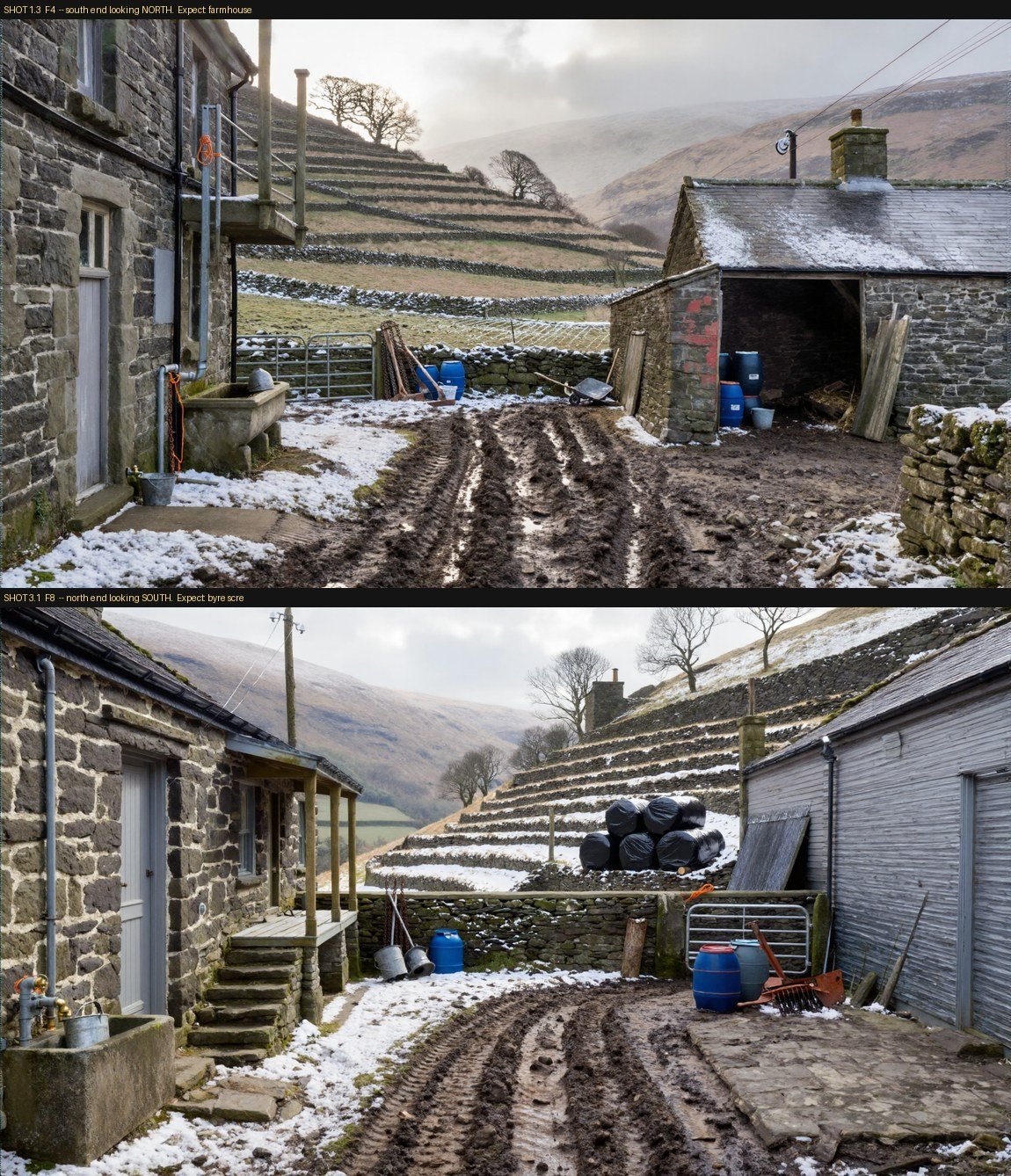
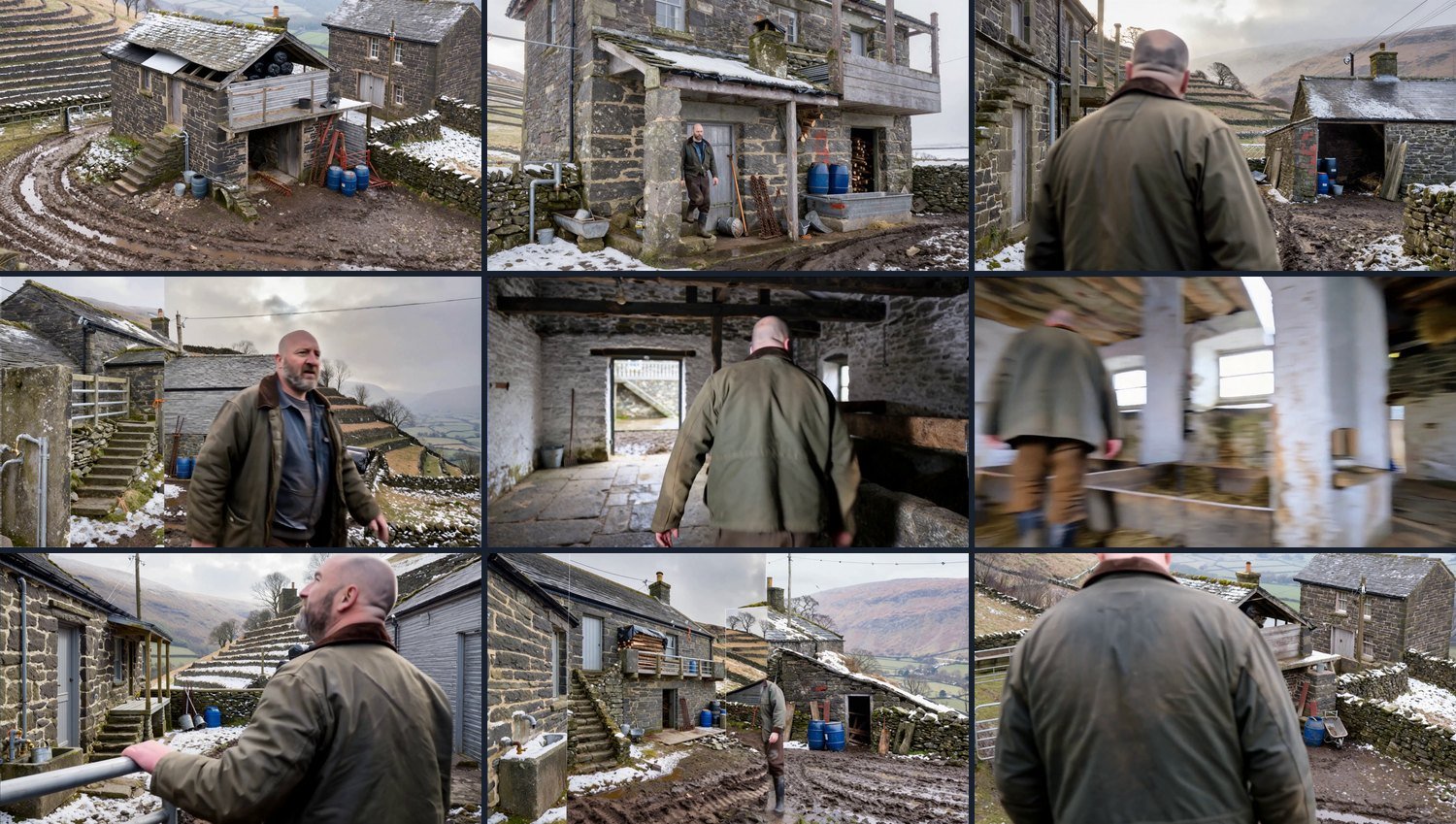
We built a nine-shot sequence on a mountain farm and designed it so that if the continuity broke, you would be able to see it break. The sharpest test in it was the simplest: stand a camera at each end of the same farmyard, pointing at each other. The farmhouse is on the west side, so it has to be on the left of one frame and the right of the other.
It is on the left of both. Not because the drawing was wrong — the drawing was right — and not because we forgot to say so. We said so twice, in two different ways, and it made no difference.
Cameras pointing at each other
2
Metres apart
17.5
Frames with the farmhouse left
2 of 2
Attempts to argue it round
2
That worked
0
Section 1
What a reverse angle is, and why it is the hard one
If you film two people talking, you shoot one over the other’s shoulder, then walk round and shoot the reverse. Everything swaps sides. The audience never thinks about it, but they notice instantly when it goes wrong: the room seems to flip, or two people who were facing each other are suddenly facing the same way.
So a reverse angle is the strictest thing you can ask a set to do. It is not enough for the model to make a convincing farmyard. It has to make this farmyard, and then make it again from the other end, with everything on the other side.
We give the model a grey drawing of the set to follow — brightness means distance — and a written description. From the north-looking camera the drawing puts the byre, the long low animal building, plainly on the left, because it is the nearest thing in shot. The photograph came back with the farmhouse there instead.
The drawing’s massing was obeyed and its identities were not. Big wall near-left, smaller building right, ground running away between them — all correct. Which building is which — assigned the other way round.
Section 2
We told it. Twice. In the way that is supposed to work.
The project’s own rule for this, learned the hard way, is that every feature of a set must be given a compass direction and its translation into this particular frame, in the same sentence — because left and right belong to the camera, not to the room. So we wrote it out for both buildings, twice over, naming the materials that tell them apart.
Nothing moved. What did move was something we had not asked about: the external stone stair detached itself from the farmhouse and reappeared as a flight of steps cut into the hillside behind. Then we tried enforcing the drawing much harder. The frame changed a great deal, the farmhouse still could not be found convincingly on the right, and the surfaces — the wet limestone, the mud, the moss on the roof slabs — got markedly worse, which is exactly the trade that made us stop enforcing it hard in the first place.
An honest limit. One random seed per attempt, one location. The direction of the result is not ambiguous, and it independently repeats a finding from last session on a completely different set — an arcade in an Italian street that also landed on the wrong side and also held that wrong side across a reverse angle. But the numbers here are three pictures, not thirty.
Section 3
The rule this produces is about carpentry, not writing
The model would rather be consistent with its own other pictures than obey the geometry. For cutting a film together, that is the mild failure. What breaks a cut is a set that changes between shots — different roof, different door, different stone. This set does not change. It is stubbornly the same farm from every angle. What it will not do is tell the audience which way they are facing.
You cannot shoot a reverse angle by turning the camera round. If a sequence needs one, the two ends of the set have to be built physically unlike each other — so that “which end am I looking at” is answered by what is in the frame, not by which side it is on.
Last session built a street with a tall thin obelisk at one end and a wide low fountain at the other, purely so that two roundabouts could not be confused in a test. That turns out not to have been a neat experimental trick. It is the only thing that works. Our farm has a farmhouse and a byre that are genuinely different buildings, and it still was not enough, because both ends of the yard look alike.
Section 4
The other half of the session: a control nobody had ever used
The video model takes a picture to start the clip from, and — optionally — a picture to end it on. In four months nobody here had ever filled in the second one. It is the only control that acts on where the actor ends up, which is precisely what the cheaper of our two methods cannot do.
It works, and it is much stronger than expected. The clip’s last frame matches the picture you supply at 25.0 decibels against 13.9 with nothing supplied — a tighter grip, in fact, than the model has on the first frame.
Ending, commanded
25.0dB
Ending, left alone
13.9dB
Joining two clips
31.8dB
Extra cost
+13%
Seeds
3
But it does not do what the name suggests. It does not glide toward your ending. It cuts to it — the clip plays freely, then about halfway through the picture changes to the one you supplied, and stays there.
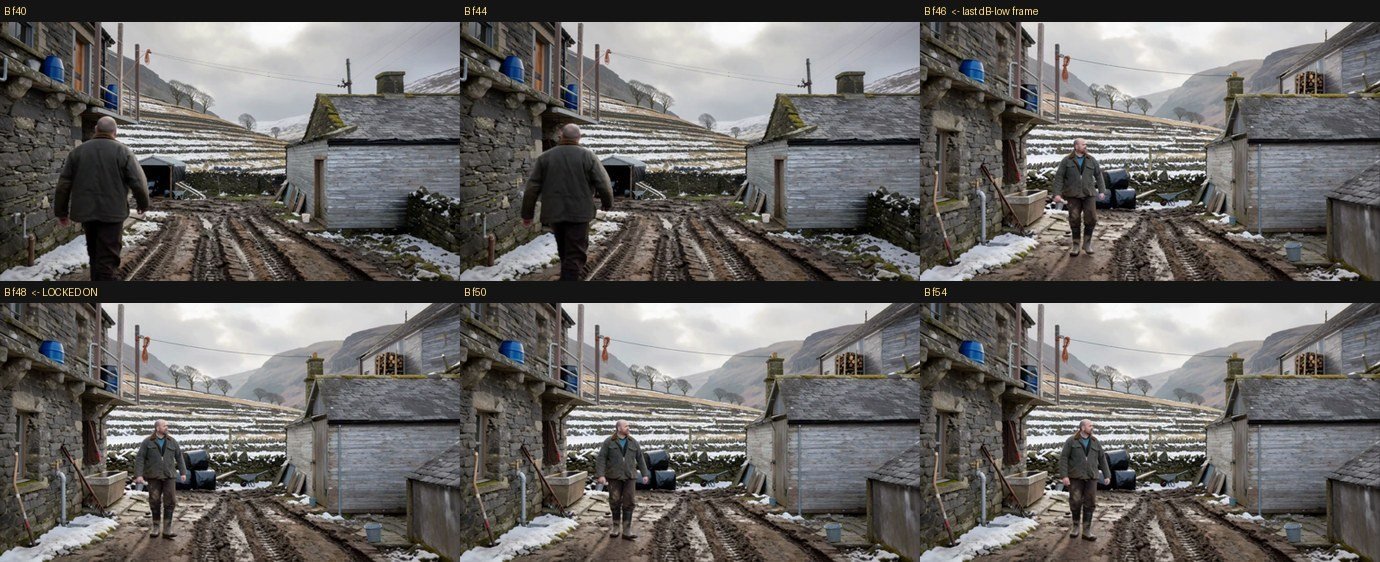
Which turns a weakness into a use. Make one clip’s ending the picture the next clip starts on, and the join between them measures 31.8 decibels — effectively invisible. That is a way to build one long take out of two renders. It is the wrong tool for cutting between two different camera angles, where you actually want the audience to notice.
And it may have solved something that has been open since Tuesday. A plain five-second shot, with no ending supplied, has been cutting itself in half at exactly the same point in every clip, and rewriting the script never moved it. It now looks as though the model builds every clip as two segments no matter what — and supplying an ending is simply how you choose what the second one shows.
Section 5
Which led straight into a mistake of mine, and a better one to make
I then shot a nine-shot sequence on the farm and decided not to use that ending control, reasoning that its cut lands about halfway through the clip while I only keep the first two seconds. That confused where the cut lands with where the influence starts. My own measurements from that morning say they separate at a tenth of the way in, not halfway.
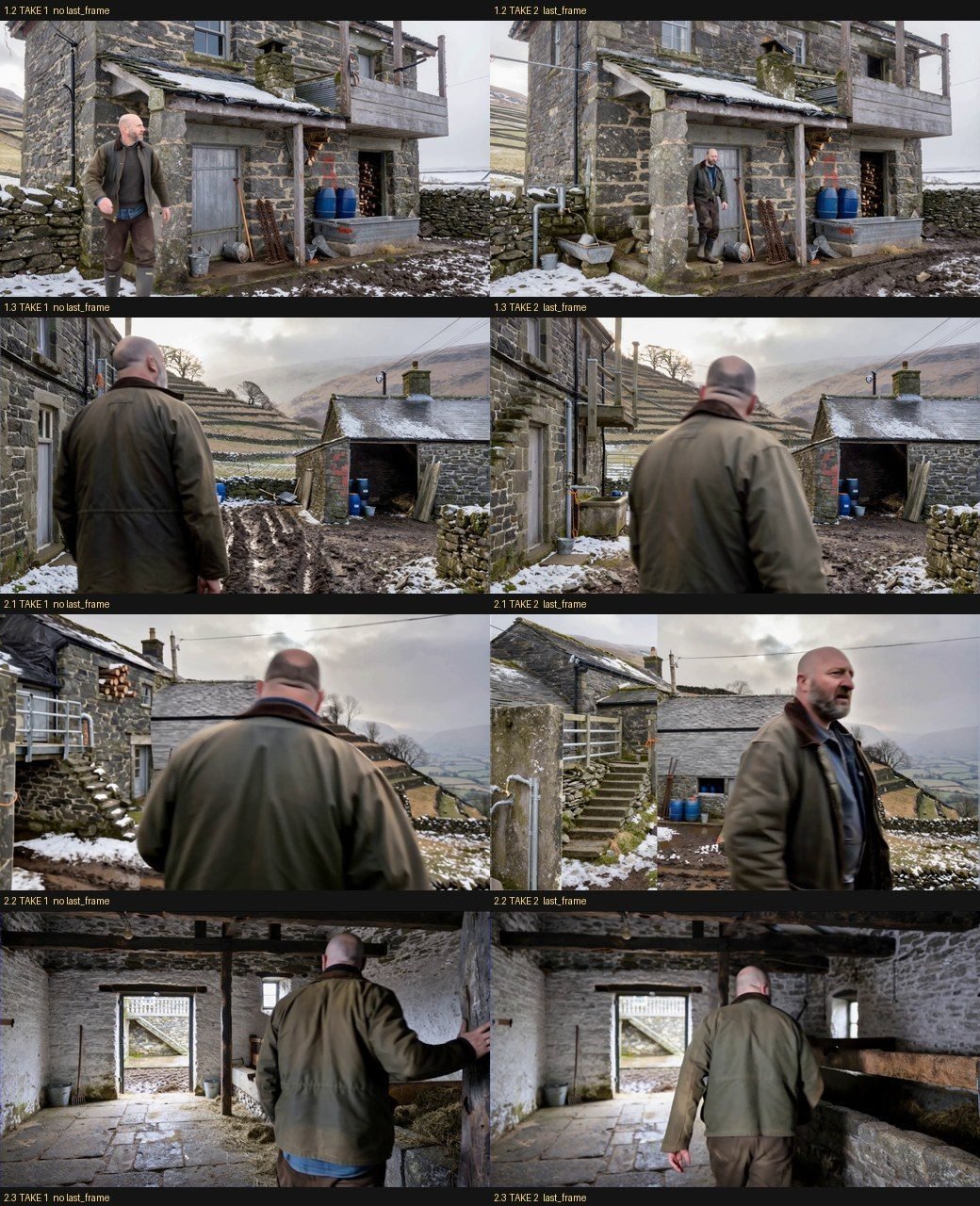
It mattered. In six shots out of nine the man was simply generated next to the lens — large, back to camera, filling a third to two-thirds of the frame — whatever the plan asked for. Five different requested actions, one stereotyped result. His clothes were right every time; it was never the wardrobe that was broken.
Worth separating out, because it is the good news. The place held in every single frame — nine cameras, two interiors, an aerial wide and a close-up, and it is one farm throughout. The hardest thing the plan asked for works: standing inside the barn, looking out through the doorway, you can see the farmhouse stair twenty metres away across the yard. The set, the plates and the planning were fine. One thing failed, six times, and it was the performer.
So I shot all nine again with one argument changed: a picture of where the man should finish each shot.
Shots improved
6/8
Worst join, before
0.098
Worst join, after
0.026
Bookend drift, before
−16pts
Bookend drift, after
+1.8pts
The sequence was built around one risky cut — out of the dark barn, straight to the yard seen from the far end — and I wrote down beforehand that it would be the first thing to break. It was, comfortably the worst of the eight joins. With an ending supplied it became one of the best. And the very first and very last shots are the same camera eighteen seconds apart: they drifted sixteen brightness points in the first attempt and under two in the second.
But the prediction I got wrong is the most useful thing in the session. I expected the overall brightness spread across the sequence to improve by about a third. It improved by eight per cent — while the join above improved four-fold. Averaging across a sequence buries the thing an audience notices. A sequence contains an aerial wide, a close-up of a water trough, a bright yard and a dark barn, and those shots are supposed to look different. Measure the joins, and any two shots from the same camera. Nothing else.
Section 6
What we still cannot do
The man in these nine shots is not Gabe. There are two ways to make video here, and they do not overlap: the method that reproduces our built location exactly has no slot for a reference photograph at all, and the method that holds a specific face invents its own farm — it scores 11 against the real location where the other scores 25. Choosing one is choosing which half of the film to get right.
That is the biggest thing still missing, it has been missing for three sessions, and nothing found this week moves it.
Postscript, written the following day. Two things in this post have moved. The reverse angle can be shot after all — but only inside a single render, and only if you ask for it as a relation (“the opposite end of the same yard”) rather than as a compass bearing, which is what failed here. And the choice in the section above is worse than it looked: the method that holds a face also refuses to put the actor where you ask, so the real rule is to match the method to the shot size. Both are in the next post.