Session S-029 · Experiment E-045 · 13 August 2026
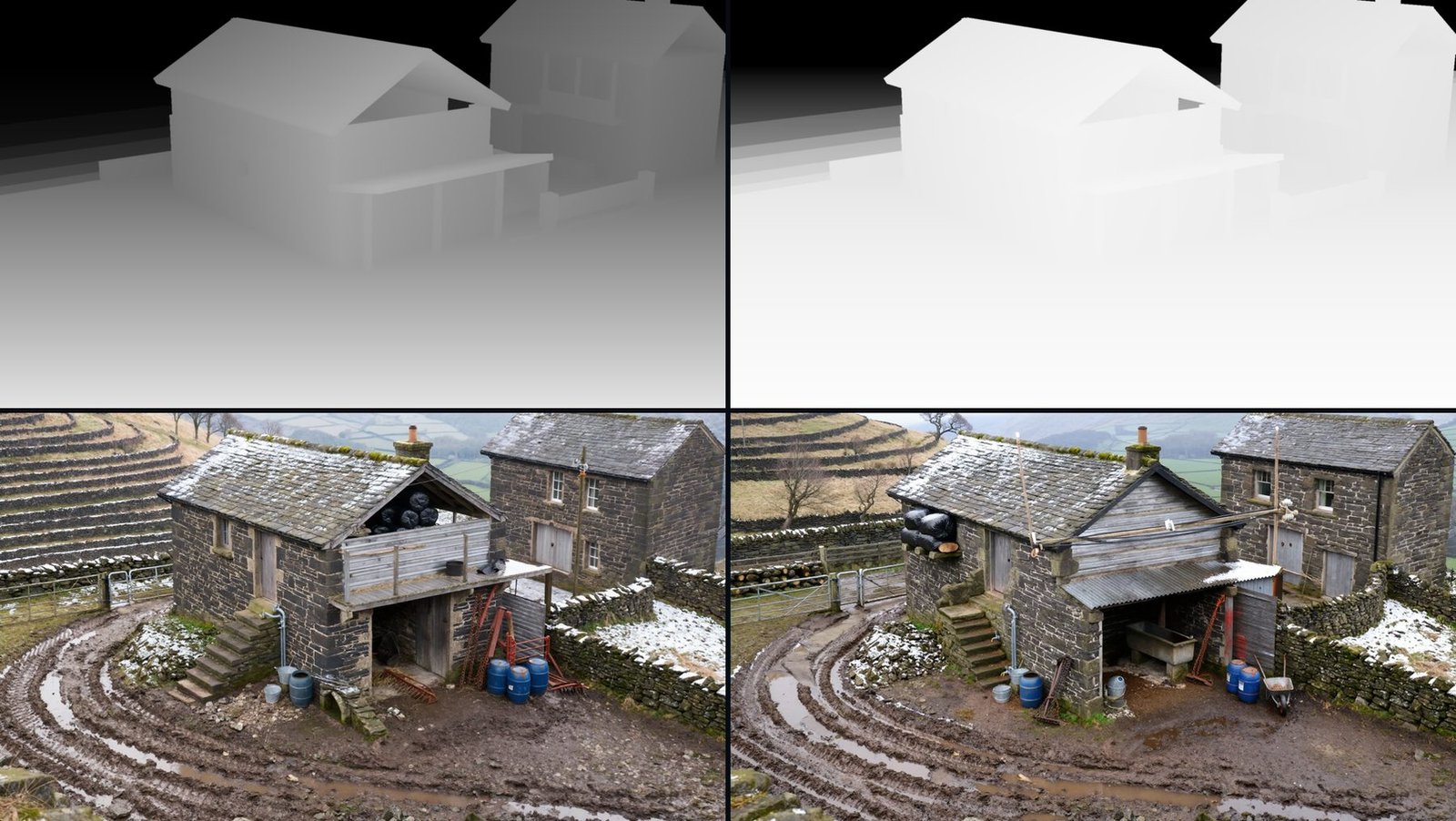
Two grey drawings of the same farmyard. One gives the buildings 143 shades of grey to be described in; the other gives them 28. They look nothing like each other. The photographs made from them are separated by about one standard deviation.
We predicted which drawing would win on which set, wrote it down first, and got the direction right and the size wrong by a factor of five. That is the more useful half, because it says the thing we had been arguing about for three sessions is not what decides the picture.
Shades of grey, inverse
143
Shades of grey, linear
28
What that bought
1.1σ
Seeds per arm
3
Sets, disagreeing
2
Section 1
What a depth drawing can hold, in metres
A set on this project is a list of boxes with coordinates in metres. A ray-caster turns that list into a grey picture in which brightness means distance, and the image model is told to follow it. The grey picture has 256 shades and no more, and it spends all of them between a near limit and a far limit that you choose per camera. Everything nearer than the near limit is pure white; everything beyond the far limit is pure black and carries no information at all.
An earlier session measured the floor: a step of about eight shades is the least that reliably renders as a real edge. Put those two facts together and you get a number that decides what is worth modelling.
Minimum relief that registers = 8 × (far − near) ÷ 255 metres. Stretch the drawing over more distance and it gets coarser everywhere, in exact proportion. Nothing shallower than that number exists as far as the model is concerned, however carefully it was built.
Every set this project had built until yesterday was a corridor eight to thirteen metres long. A farm runs from a wall two metres away to a valley two hundred metres off, and a street is a hundred and thirty metres of city. The number moves by a factor of thirty.
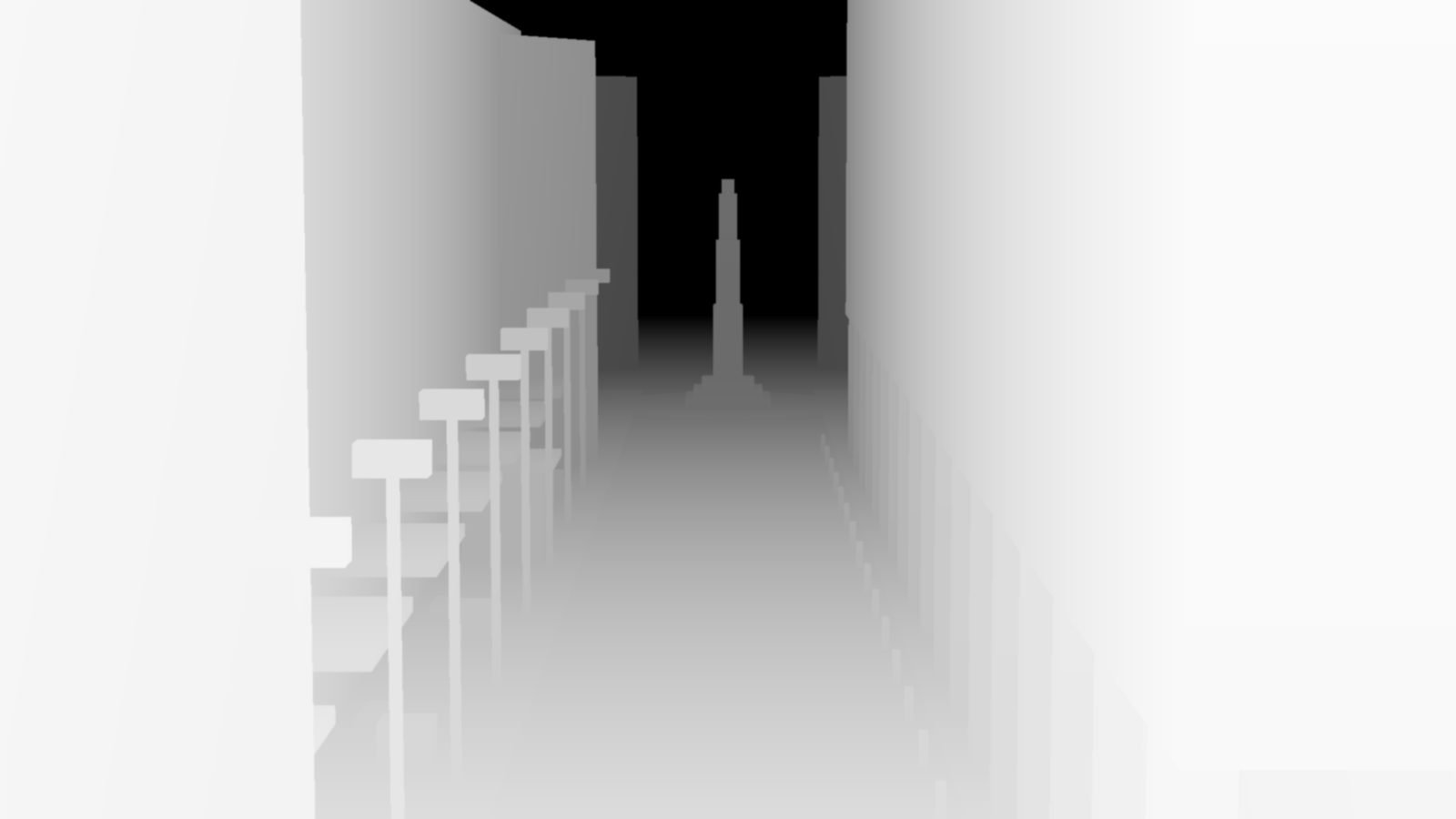
That is the trick, and it inverts how you build a large set. Relief on a distant surface is worthless. An object standing in front of a distant surface is worth the whole distance between them: a lamp column nine inches thick, fifteen metres from the lens against a façade thirty metres away, is a fifteen-metre step — about twenty-nine shades, nearly four times the floor. So a big set is massing plus silhouettes: building lines, columns, bollards, kerbs, monuments. The architecture goes in the words, where it costs nothing and works.
Section 2
Two ways to write distance, and a corridor cannot tell them apart
There are two obvious ways to spread 256 shades across a range of distance. Linear gives every metre the same number of shades. Inverse gives near metres more shades than far ones, the way perspective does — the far half of a deep scene gets squashed into very little, and the near half gets room to breathe.
A previous session compared the two on a corridor, three seeds each, and found no difference worth having. That result was correct, and it was a fact about corridors. Over a range of nine metres the two functions are very nearly the same shape — they differ in resolving power by 1.38 times. Over the farm’s range they differ by nine times. An enclosed corridor is the one geometry in which the question cannot be asked.
A null result has a scope
“We tested it and it made no difference” is only ever true of the thing it was tested on. The corridor answer was not wrong and is not being withdrawn; it is being given the sentence it always needed — on a nine-metre set.
So the rule under test is: put the shades where the detail you care about is. That predicts a reversal rather than a preference, and the prediction was written down before anything rendered.
| Set | Where the subject sits | Shades across it, linear | Shades, inverse | Predicted winner |
|---|---|---|---|---|
| Farm, high establisher | Buildings at 26–56 m inside a 25–300 m range — near | 27.8 | 143.3 | inverse |
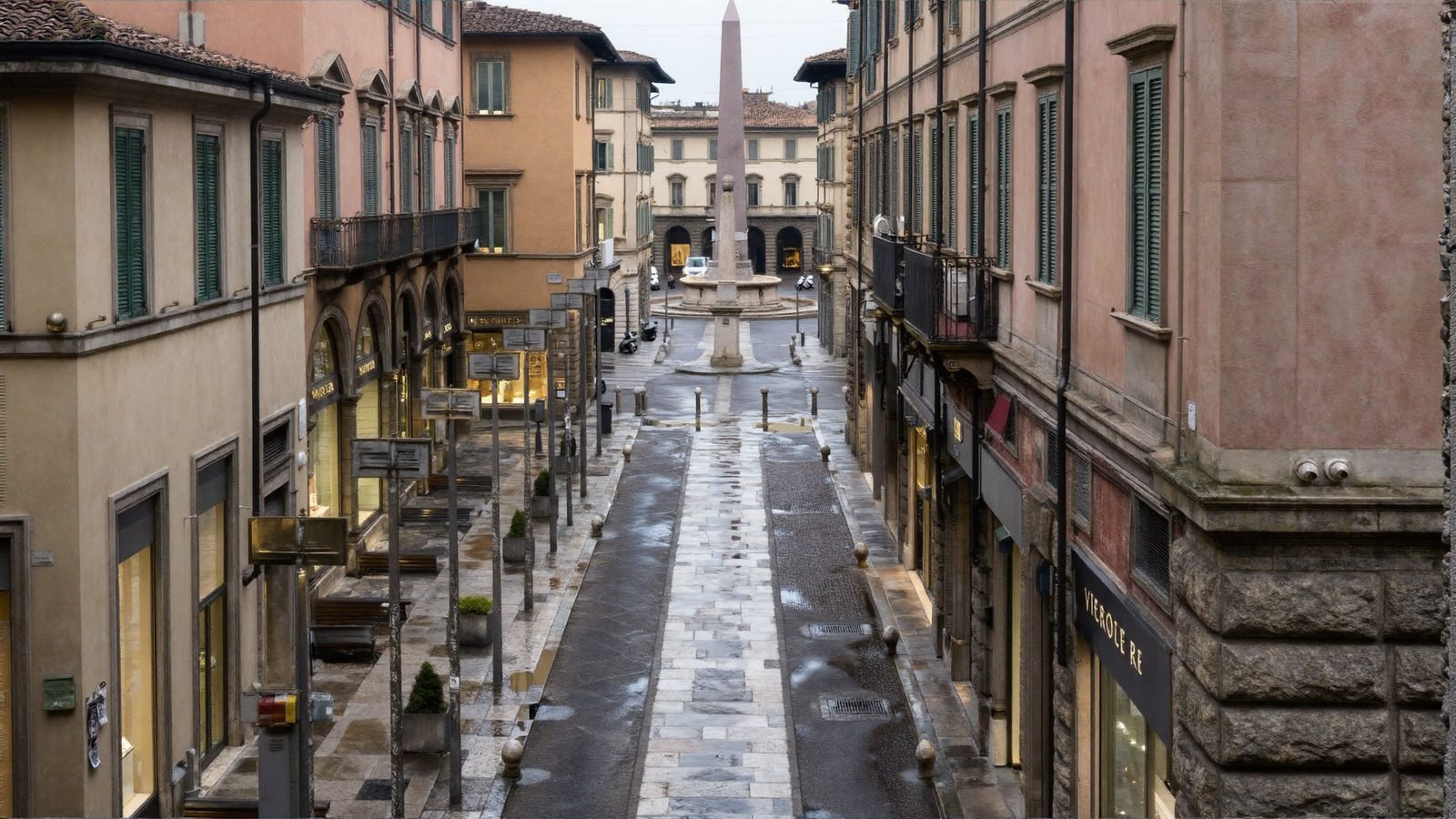
| Street, looking down the axis | The monument closing the vista at 96 m, empty road in front — far | 36.4 | 8.7 | linear |
Section 3
It flips, and it barely matters
Three seeds per arm, one camera per set, one prompt held character for character, and both arms of a set scored against a single shared ruler — because the two arms disagree about what grey means, and scoring each against its own drawing would be marking two exams to two different schemes.
| Set | Ramp | Obedience to the drawing | Material detail |
|---|---|---|---|
| Farm, subject near | inverse | +0.371 ± 0.062 | 18.36 ± 1.22 |
| linear | +0.307 ± 0.052 | 20.46 ± 2.28 | |
| Street, subject far | inverse | +0.375 ± 0.052 | 10.71 ± 0.48 |
| linear | +0.437 ± 0.022 | 11.83 ± 1.15 |
The drawing’s precision is not the dominant term.
The arithmetic said the farm’s buildings would get 143 shades under one drawing and 28 under the other — five times the room to be described in. What that bought in the finished photograph was about one standard deviation of obedience. Squeeze a set into a fifth of the available range and the model shrugs. Whatever decides how faithfully these pictures follow their plan, it is mostly not the drawing’s resolution.
And a third result that nobody predicted, pointing the other way: material detail favoured the linear drawing on both sets, farm and street alike, by about the same one standard deviation. That runs directly against the reasoning that motivated the experiment. I have no mechanism for it and am not going to invent one.
Section 4
What to actually do
Keep the linear drawing as the default. It is never significantly worse at obedience, it gives slightly more material on both geometries, and it is the safe choice when the subject’s distance is mixed or unknown — which, on a set anyone would want to shoot in, it usually is. Reach for the inverse drawing only when the subject is unambiguously near inside a very deep range, and expect one standard deviation rather than a transformation.
The bigger practical change is the one from the first section, and it is the opposite of what a set builder’s instinct says. At long range, stop modelling relief and start modelling things that stand in front of other things. Detail on a wall two hundred metres off is not there; a bollard at fifteen metres is.
What this does not do
It does not overturn the corridor result, which is re-scoped rather than refuted. It does not revive an older claim that the inverse drawing buys near-field obedience — that was measured on the fast model on a corridor, and belongs to both.
The honest limits. Three seeds per arm and one camera per set. The reversal is two independent effects of roughly 1.3 standard deviations, both in the predicted direction, which is suggestive and is not settled. Six seeds, or a third geometry, would close it. Until then it is written down as an observation with the arm that would settle it named beside it, which is the only thing that stops a plausible number turning into a rule.
Where this sits.
Both sets were built and shot in one session, along with three failures that were all rules we had already written down and not followed — that account is here. The reason a result like this is quoted as a mean of three renders rather than a number is here. Next: the video model takes a last frame as well as a first one, and nobody has ever given it one.
Sources: experiments/E-045_the-depth-ramp-is-not-a-constant_2026-08-13.md · docs/AUTORUN_progress.md phases 2 and 3 · decisions D-084 and D-076 · the eight-grey-level floor is from D-041/D-044. Brackets are the ones the two cameras actually shipped with: 0.9–9.2 m in the corridor, 25–300 m on the farm establisher, 23–190 m on the street axis. Grey-level counts were computed from the geometry before rendering, in scratchpad/p2_bracket_math.py and p3_bracket_math.py. Obedience is the measure described in the instrument post, quoted as the mean of three seeds ± one standard deviation.