Checkpoint 3 · Three questions · about two minutes to watch
There are two engines for turning a still into a moving shot, and they are mutually exclusive. One holds the location and cannot accept a photograph of a person. The other holds a person’s face and invents its own room. There is no third option and no way to combine them.
I have been choosing between them on numbers. This is the single biggest standing decision on the project and you have never been shown the two side by side.
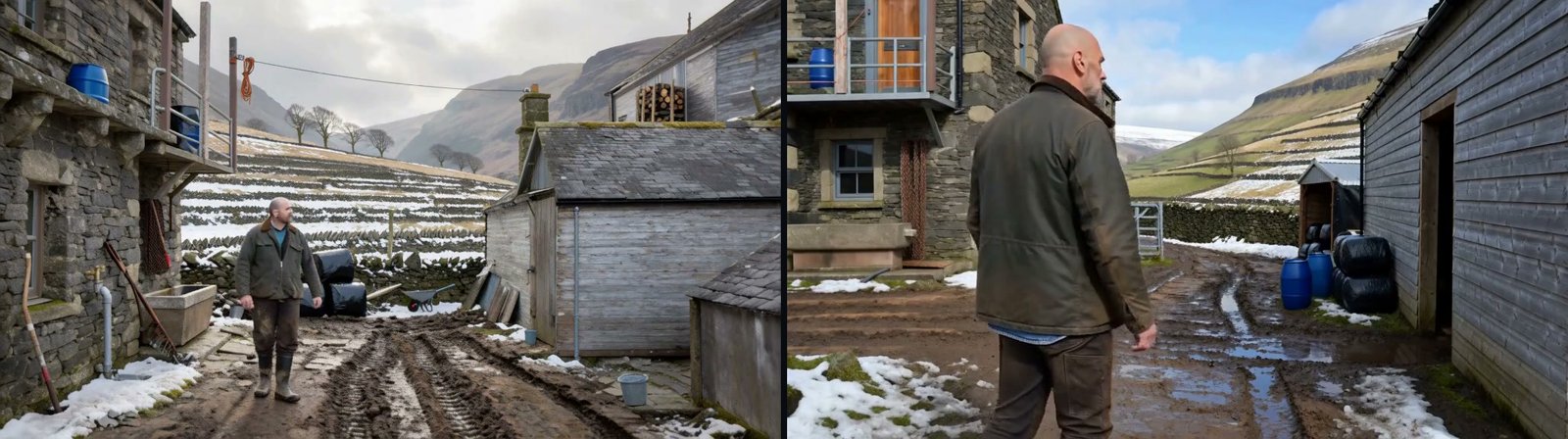
The same shot, made both ways. Same farmyard, same instruction, same random start. On the left, the engine is handed our finished photograph of the yard and told to start there. On the right, the engine is handed two photographs of your face and a photograph of the yard, and asked to build the scene.
holds the placeThe yard as we built it
Opens on our exact photograph. Cannot take a face reference — no such input exists on this engine.
holds the faceYour face, its farm
Given two photographs of you plus one of the yard, and left to compose the scene itself.
What the numbers already say
Holds the location we built
23.7 vs 10–12
Can accept a face at all
no vs yes
Actor’s size in frame, asked for small
43% vs 60–86%
Render cost
1× vs 2.1×
On paper the left-hand engine wins everything except the face. My working rule has been: use the left one for wide shots where the figure is small, the right one for close-ups where the likeness matters. That rule was decided entirely on numbers and has never been sanity-checked by eye.
What I need from you
Three questions
1 · Is the right-hand farm acceptable, or is it the wrong place? It is not our yard — it did not use our drawing. The question is whether that matters to you as a viewer, or whether “a plausible hill farm” is fine as long as it is consistent.
What it changes: if a plausible-but-different farm is acceptable, the whole depth-drawing apparatus becomes optional for some shots and we get a lot faster. If it is not acceptable, the right-hand engine can only ever be used where no location is visible.
2 · Does the face on the right look like you? Be blunt. This is the entire justification for that engine existing in our pipeline.
What it changes: if the likeness is not good enough, we have been paying double the render time and giving up our locations for nothing, and the honest answer is that this film cannot show its lead actor’s face — which is a story decision, not a technical one, and it would be yours to make.
3 · Where does the man belong in a shot like this? Left puts him small in the yard; right puts him large and near. Which is closer to the film you want?
What it changes: this decides the default shot size for the whole production, and therefore which engine most shots use. If you want him small and in his landscape, we mostly never see his face and that has to be designed around.
Reply like CP-3: 1 wrong place, 2 not really, 3 small. Days later and in another conversation is fine.
Honest limits
- One attempt per engine here, not three. The numbers above come from properly repeated runs, but the two clips you are watching are a single attempt each — that is what exists on disk. If your answer is close, tell me and I will render three of each; it costs about fifteen minutes.
- The left-hand clip is the good version of itself — it has the end frame that checkpoint 2 is about. I did not want to compare a well-set-up shot against a badly set-up one.
- Neither is a close-up. Both are wide. The likeness question is genuinely harder to answer at this size, and that is itself informative — if you cannot tell at this distance, then for wide shots the face engine buys nothing.