Checkpoint 2 · Four questions · about six minutes to watch
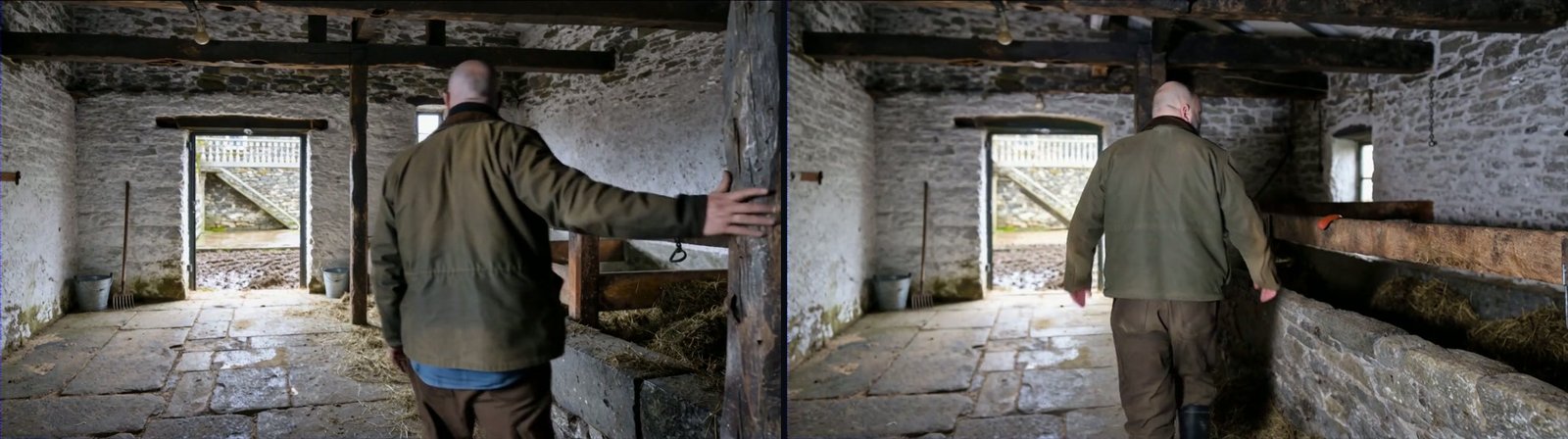
This is the most important thing on the site and it has been sitting on a hard drive, unwatched, since 13 August. Nine shots of the farm sequence, cut together into forty-seven seconds — twice. Same nine camera setups, same story, one difference in how they were made.
I have audited these shot by shot against eleven separate continuity checks. What has never happened is anybody watching them as a film.
Why this one first. Every other question on this site — which engine to use, how to keep a yard looking like the same yard, whether the sound works — is a question about a component. This is the only one that asks whether the components add up to anything. If the answer is no, the rest is premature and we should be finding that out now rather than after another fortnight of decibels.
The difference between the two
One of them tells each shot where to end
Each shot is generated from a still photograph that we make first. The video engine also accepts a second photograph — an end frame — which says where the shot should finish. For a long time we never used it, and the man consistently walked straight up to the lens and stood there with his back to us, whatever the script said. In the version on the right, every shot is given an end frame.
Measured, that change improved six of eight shots and pulled the actor out of the lens. Measured is not the same as good, which is why you are here.
ANo end frame
Each shot given only its opening still. 47 seconds, nine shots.
BEnd frame on every shot
Each shot also told where to finish. 47 seconds, same nine shots.
What I need from you
Four questions, and what each one changes
1 · Does this read as one place? Ignore the acting and the story. Just: over forty-seven seconds and nine camera setups, do you believe you are looking at a single farm — or does it feel like nine photographs of nine similar farms?
What it changes: if it reads as one place, the copying trick I found last night is a refinement and we should press on to longer sequences. If it does not, that trick becomes the main event and every shot in the film has to be built from its neighbour.
2 · A or B — which is the better film? Not which is more correct. Which would you rather watch. If B is better, say roughly why: is it the man’s position, the pacing, something else?
What it changes: B costs about 13% more render time and needs a second still per shot, which is real work. If you cannot tell them apart, we drop it and get faster. If B is clearly better, it becomes mandatory and the extra still gets built into the pipeline.
3 · Where does it break? There will be a moment where you stop believing it. Give me the shot number or roughly the seconds and one word for what went wrong — jumped, melted, wrong place, bad acting, boring. One or two is plenty; I do not need a full list.
What it changes: this is the one I most want. I have been fixing what I can measure, which is not necessarily what breaks the illusion. Whatever you name becomes the next thing I work on, ahead of anything on my current list.
4 · Play one with the sound on. Is it the right sound? It should be a cold hillside — wind, a trough running, cattle inside the barn, two crows a long way off. No music.
What it changes: the sound is written into the same instruction as the picture, and we have measured that writing it changes the audio. Nobody has ever checked whether it is the sound we asked for. If it is wrong, that is a whole channel we thought we had and do not.
Reply however is easiest — CP-2: 1 yes, 2 B because of the man, 3 shot 5 melted, 4 no crows is a perfect answer. It can arrive days from now in a different conversation; the numbering exists so nobody has to re-read anything.
Before you judge it
Three things that are honestly wrong with this test
- This is the pipeline as of 13 August, not as of today. It predates the copying trick that fixed environment continuity, and it predates finding out that telling the model which side of the frame something goes on does nothing. So it is a fair picture of where we were two days ago, and a slightly unfair one of where we are now.
- There is no editing judgement in it at all. Nine shots, in order, each running its full 5.2 seconds, cut end to end. No trimming, no choosing, no rhythm. A real edit would throw away half of every shot. Judge the material, not the cutting.
- The man’s face is not his face. This route holds the location well and has no way to accept a photograph of a person, so the actor is whoever the machine invented. That is checkpoint 3’s question, not this one.
The sequence is Partenza — the opening of a film about a man coming down off his family’s hill farm into the city. These nine shots are him leaving.