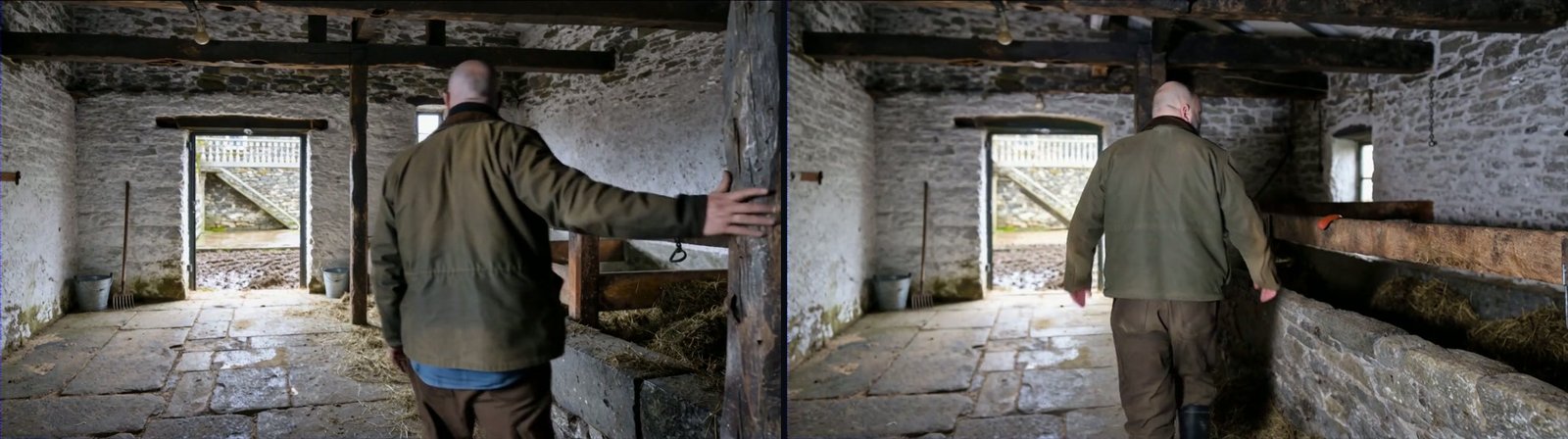
Checkpoint 2 · answered · 15 August 2026
You watched the forty-seven-second farm sequence end to end — the first time any human had watched anything this project made as a film rather than as evidence. It took no rendering at all and it overturned more than any night at the machine has.
Both versions were wrong, and the one I had built to fix the other was the worse of the two.
What was asked
A complete nine-shot farm sequence, cut together twice, with one difference in how the second version was made. It had been audited shot by shot against eleven continuity checks and never once watched. Four questions, and the real one was whether it read as a single place.
What you said
The place does look somewhat coherent in the elements… but definitely not navigatable by a human. It does not look as one place, just a collage of similar places… the man walks well… the man looks pretty consistent.
That was the version without the end frame. On the version with it — the one I had built specifically to solve a problem the measurements said was serious:
Frames are incoherent… things disappear, transform, appear mid-shot. Stills appear for a few seconds. Shots are cut weirdly. It is just unusable material.
You preferred the first. On the opening shot of both versions you named something no instrument here had ever looked for: “the roof of a house being blown up by the wind and then coming back down to its original position — this kinda kills the suspension of disbelief.” And on the sound, which I had expected to be the weakest part: “actually coherent across, however minimal.” You could hear wind, steps, cattle, water, the hand-washing as he washes and the gate as he touches it.
What changed because of it
The end frame was withdrawn as a default
Your sentence turns into a number cleanly. With an end frame supplied, the frozen tail — the part of a shot where the picture has arrived and simply stops — averages 16.9 % of each shot and reaches 34 %. Without one it is 4.4 %. And the cut lands anywhere from 16.4 % to 63.9 % of the way through, so it cannot be planned around. “Shots are cut weirdly” was the measurement, in your words, before I had made it.
Two rules in our own recipe contradicted each other
This is the part that stings. One rule said one photograph serves a whole sequence, never one per camera. It was established on a route where the camera cannot be aimed at all. A later rule moved production to a route where the photograph is the first frame of the shot — which makes one photograph per camera mechanically unavoidable. The recipe was asking for something impossible, and had been for four days. The farm sequence was shot with eight photographs for nine shots. That is the collage you saw, and it was findable by reading two lines of our own notes side by side.
You remembered the record better than I did, twice in one conversation. You said it plainly — “we have so much knowledge flying around that either I or you or both of us aren’t really being able to put it together” — and you were right. I listed the actor’s controls from memory and left out the only one that works, from a document written so that nobody would have to remember.
What is still open
The roof. Rigid things deform while the camera moves, and every instrument this project owns compares still frames — so an entire class of failure has been invisible by construction, not by oversight. It is still invisible. Nothing has been built for it.
The lesson worth keeping is not about end frames.
Forty-seven seconds of film, watched once by one person, moved this project further than any measured night has. Every number in the audit said the second version was better. It was unusable. An instrument that has never been checked against an eye is a hypothesis.