Checkpoint 6 · Five questions · about four minutes to watch
You watched the farm sequence on Friday and said it looked like a collage of similar places. You were right, and the reason turned out to be a contradiction inside our own instructions. This is the same three shots, made the other way.
It fixes the thing you complained about. It breaks two other things badly. Which of those matters more is not a question I can answer with a number, and I have spent the evening proving that to myself three separate times.
What changed
One photograph instead of three
Every shot starts from a still photograph we make first — the plate. In the version you watched, each camera got its own plate. Three cameras, three plates, all from the same drawing of the same farm, all with the same words. They came back as three different farms: a small shed with a hay loft; two long buildings down a mud yard; a low house with a timber shed opposite. Nothing tied them together except the description, and a description is not enough.
In the new version, all three shots are given the same single photograph — one plate, shared. That is only possible on a different engine setting, and that setting cannot be told where to put the camera. So this is a trade, not an improvement: we buy one place and we sell the camera.
You can command the camera, or you can share one anchor across shots. Not both. That is the whole problem in one line.
The material
Three shots, cut at two seconds each, both ways
Six seconds a side. These are cut at two seconds a shot, which is what the shot cards always said — the forty-seven-second version you watched ran every shot to its full length, which is why you saw things freeze.
AA plate per camera
What you watched on Friday. Three shots, three separate photographs.
BOne plate, shared
The same three shots, all anchored to one photograph.
The other two runs of B, so you can see the spread
B was made three times over. Everything is identical between the three except the random starting number, which is how we tell a real behaviour from a fluke. These are not extras — the middle one contains the worst clip in the whole experiment and it would be dishonest to show you only the good run.
Run 2. Shot one is a write-off — a coat filling the frame, and it then stops moving for the rest of its length. Shot two is his back. Shot three is fine.
Run 3, the cleanest of the three. Shots two and three both read the yard end to end.
Exactly what to look at
Six things that are supposed to be the same object
Rather than ask whether it “looks coherent”, here are six specific things written into the farm’s description. Each one is distinctive enough that you can tell two versions of it apart. The middle row is version A, the bottom row is version B.
- The outside stone stair — eleven slabs sticking straight out of the wall, no handrail.
- The water trough — one hollowed block of stone, brimming over, brass tap.
- The barn’s big doorway — three paces wide, both plank doors folded flat back against the wall.
- The field gate — five-bar galvanised, tied to the far post with a loop of orange baler twine.
- The power pole — one creosoted pole, two black wires on white ceramic insulators.
- The roofs — thick grey stone slabs, mossy at the eaves.
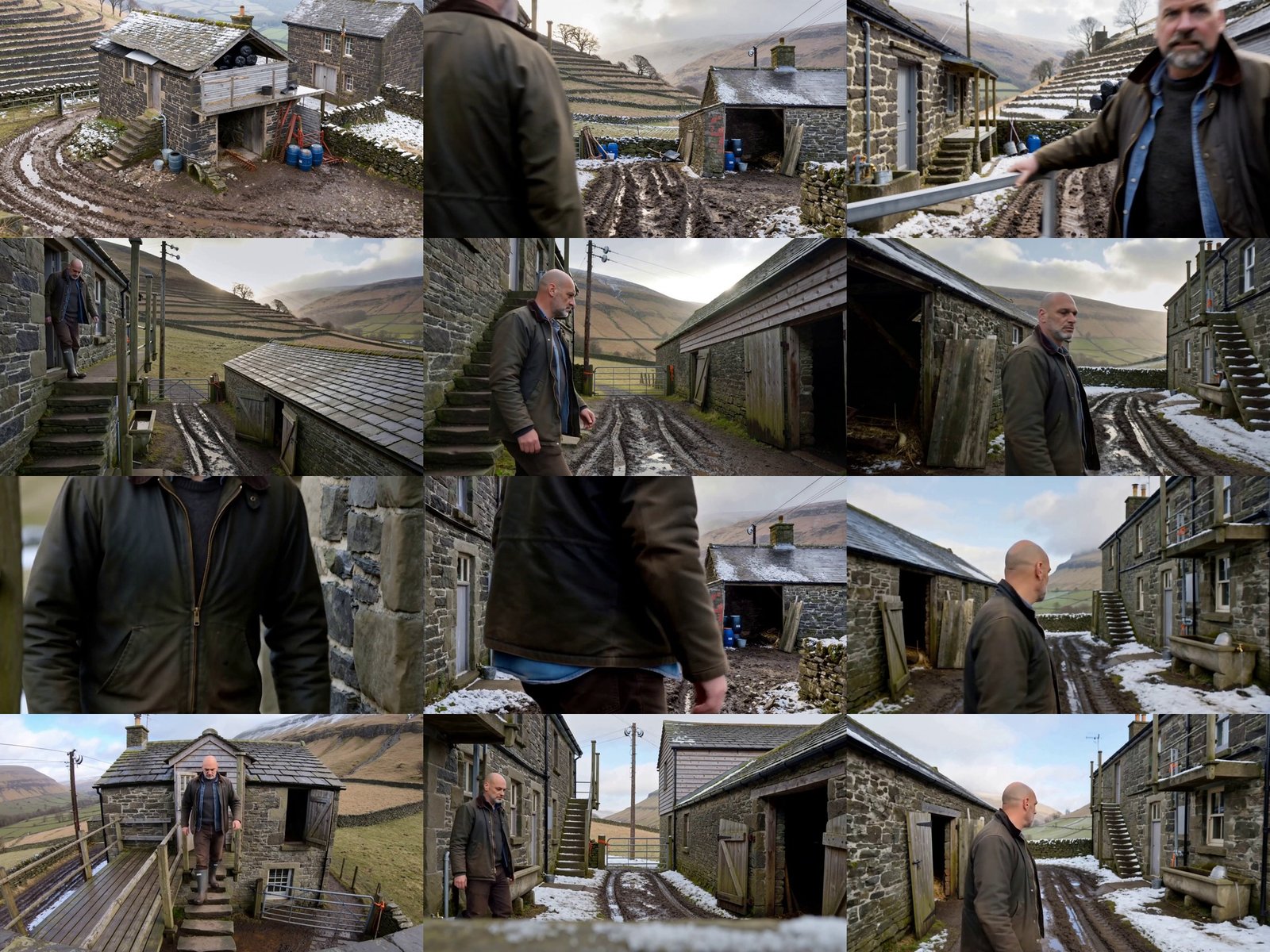
Top row: version A — a shed with a hay loft, then a low barn, then a house with a porch. Three farms. The three rows below are the three runs of version B. The same stone house with the same stair sticking out of its wall, the same barn with the same dark doorway, the same mud, the same gate. Look for the orange twine on the gate and the red paint mark on the barn stone — neither is described anywhere in the instructions. They come out of the one shared photograph and arrive in shots taken from somewhere else.
And what it costs, which is not small
Three things version B is worse at
- The camera does what it likes. Shot one was written as a wide from forty metres back and thirteen metres up, looking down on both roofs. It came back from a few metres up at the top of the stairs. On this setting there is no way to say where the camera goes — you describe a view and hope.
- The sun comes out. The farm has a written lighting rule — flat grey overcast, no sun, no hard shadows, because that is the one state two shots can be cut together in. In two of the three runs of B there is a sun behind the ridge and warm shadows on the ground. It is wrong in the same way in every shot of that run, which is at least consistent, but it is wrong.
- The set is only loosely the set. Measured against the photograph it was given, B holds roughly a tenth of the detail A does — about 10 decibels against 24. It builds a farm out of the photograph rather than the farm in it. That is why the buildings change proportion between shots even while staying recognisably the same buildings.
One thing I expected to be a cost and it is not. I was going to tell you that B puts the man in the lens. Then I looked at A properly: it does it too — its second shot is a shoulder filling the frame and its third has him large at the right. Our own notes predicted exactly this and I had not read them: without an end frame the man is generated at the lens in six shots out of nine, on either setting. So that fault is not about which engine we use. It is about asking for him to be somewhere instead of asking him to walk somewhere, which is the one instruction that has ever worked.
What I need from you
Five questions, and what each one changes
1 · Is B one place? The only question that matters. Over six seconds and three camera setups, do you believe you are looking at a single farm — and is A still the collage you saw on Friday?
What it changes: if B is one place, sharing an anchor is the mechanism and everything else becomes a matter of buying back the camera and the staging on top of it. If B is also a collage, then nothing we have makes a scene, and that is a much bigger finding than a success would be.
2 · Which would you rather watch? Not which is more correct. A is better framed and better staged. B is one place with a man in your face. Which is the better material to cut a film from?
What it changes: this decides which of the two engine settings the whole production runs on, and it is your call rather than mine.
3 · In B, shots two and three are a reverse angle — the camera at one end of the yard, then at the other, so the two buildings swap sides of the frame. In A they do not swap; the house is on the left in both, which is wrong. Does B’s reverse read as the same yard seen from the other end, or as somewhere else?
What it changes: this is the single hardest thing we have tried to do and it has failed on two different sets. If it works here it is the first time, and it changes how every sequence gets planned.
4 · Shot one is the weak one in every run of B. It was written as the big wide from up the hillside, and it never came back as that at any run — you get a few metres up at the top of the stairs instead, and in run 2 you get a coat. Is B usable without an establisher, if the two eye-level shots hold?
What it changes: I think the rule is that a camera at a different height needs its own photograph and cannot borrow one — the wide is a separate problem from the two shots along the yard. If you agree that is livable, sequences get planned in groups of shots that share an eye line. If you think a sequence is dead without its wide, that becomes the thing to solve next.
5 · The sun. In two runs of B there is a sun and hard shadows where the farm is supposed to be under flat grey cloud. Does that read to you as wrong, or does it just look like a better morning?
What it changes: if you can live with it, the lighting rule becomes a preference and we stop paying for it. If it breaks the film for you, then B needs the light forced back somehow before it can be used, and that is a real piece of work with no known method.
Reply however is easiest — CP-6: 1 yes, 2 B, 3 same yard, 4 livable, 5 looks wrong is a perfect answer. It can arrive days from now in a different conversation; the numbering exists so nobody has to re-read anything.
Before you judge it
Three things that are honestly wrong with this test
- This is not one clean change. Going from A to B swaps the engine setting, the number of plates, and whether the machine gets a photograph of your face — all at once. They cannot be separated, because sharing a plate is only possible on the setting that also loses the camera. So read this as two ways of working, not as one variable.
- A is one seed and B is three. A was shot on 13 August as a sequence, not as an experiment, so there is one version of it. B was run three times to make sure its behaviour is not a fluke.
- Nothing here is measured. I built an instrument for this and it failed, three separate ways, all of them recorded. Any fixed patch of the frame ends up measuring where the camera is pointing rather than what place it is pointing at, and across three deliberately different viewpoints those cannot be told apart. The only numbers below that survive are about how closely each version follows its own photograph — and on that, A wins comfortably.
The sequence is Partenza, the opening of a film about a man coming down off his family’s hill farm into the city. These three shots are him leaving.