Checkpoint 6 · answered · by the work, not by a verdict
I asked you to choose between two bad options: command the camera, or share one photograph across shots so the place stays put. Not both. I called it “the whole problem in one line”.
That line is no longer true, and it stopped being true two days after I wrote it. The answer was not to pick a side. It was to notice we had been asking the machine to imagine a place we already owned.
What was asked
Three farm shots made the old way — one photograph per camera — came back as three different farms, which is the collage you complained about. The same three made the other way, all anchored to one shared photograph, came back as one place but with the camera doing whatever it liked. Five questions, and the first was simply: is this one place?
What changed
We already had the geometry. We were asking for it back.
Every failure of that week had one shape. A reverse angle that came back a different farm. A long camera move whose background matched its own start by nothing at all. A far distance that re-invented itself on every render. All the same illness: we had been asking a picture model to imagine geometry that was already sitting on disk.
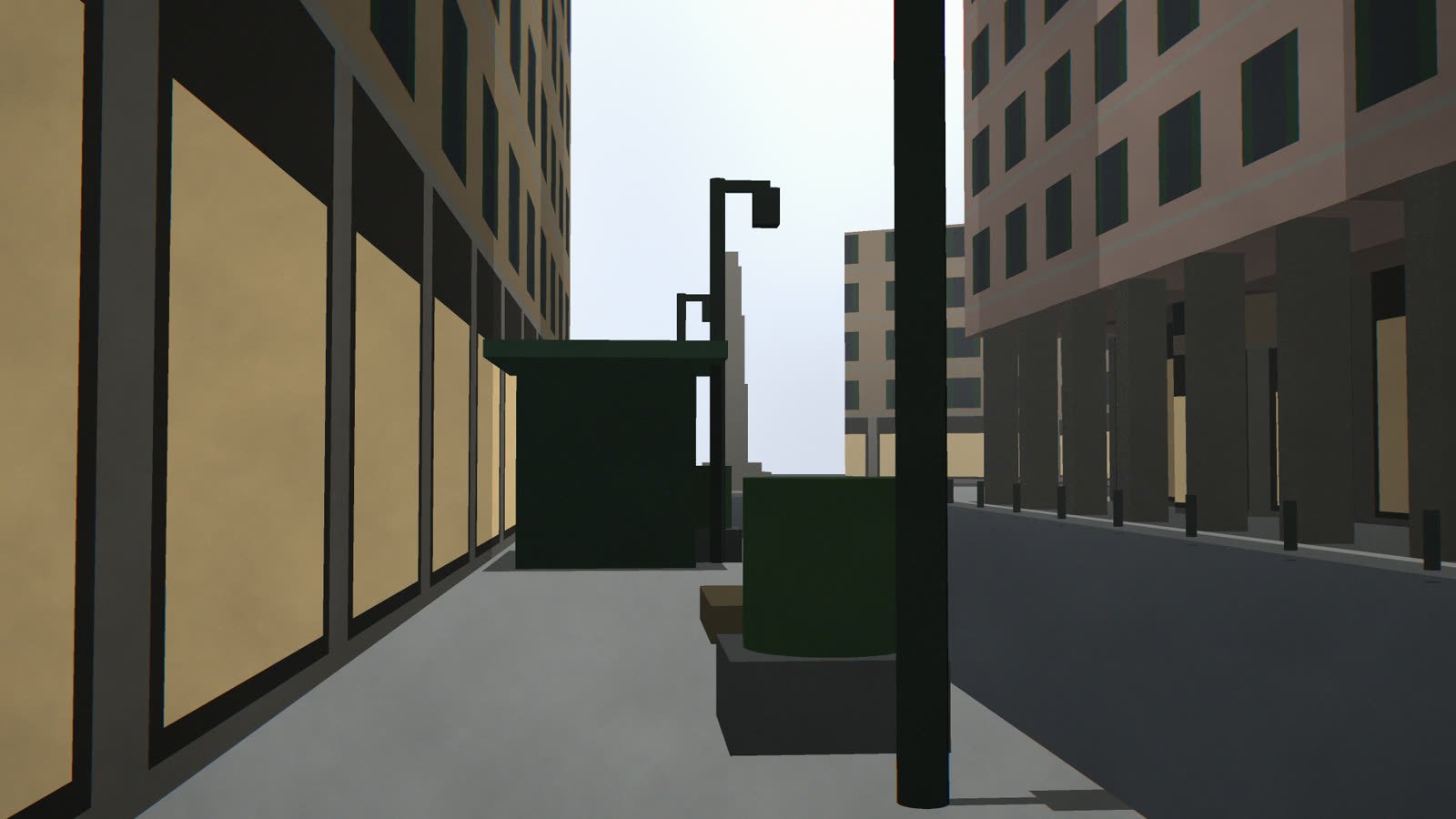
The set is not a description. It is a list of boxes with coordinates in metres, and the ray-caster that makes the grey control drawing already knows which surface every pixel hits and how far away it is. What was missing was a colour and a light. So the set is now rendered — given materials, a sky-dome light, real shadowing — and that render is handed to the model as the picture it starts from, while the grey drawing stays on the control input. Two doors, two different jobs.
Your first question, answered
Two cameras facing each other, fifty-two metres apart
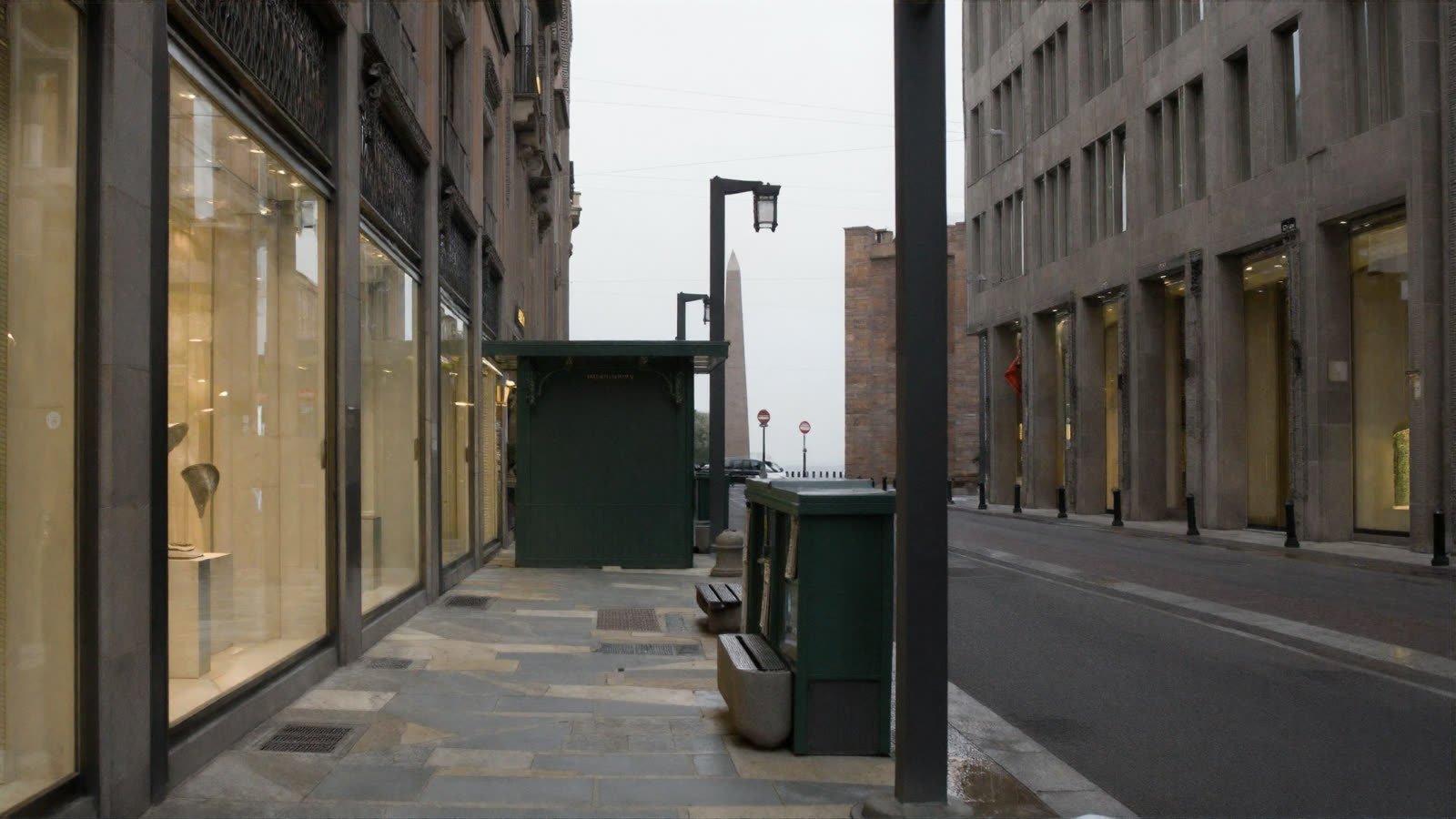
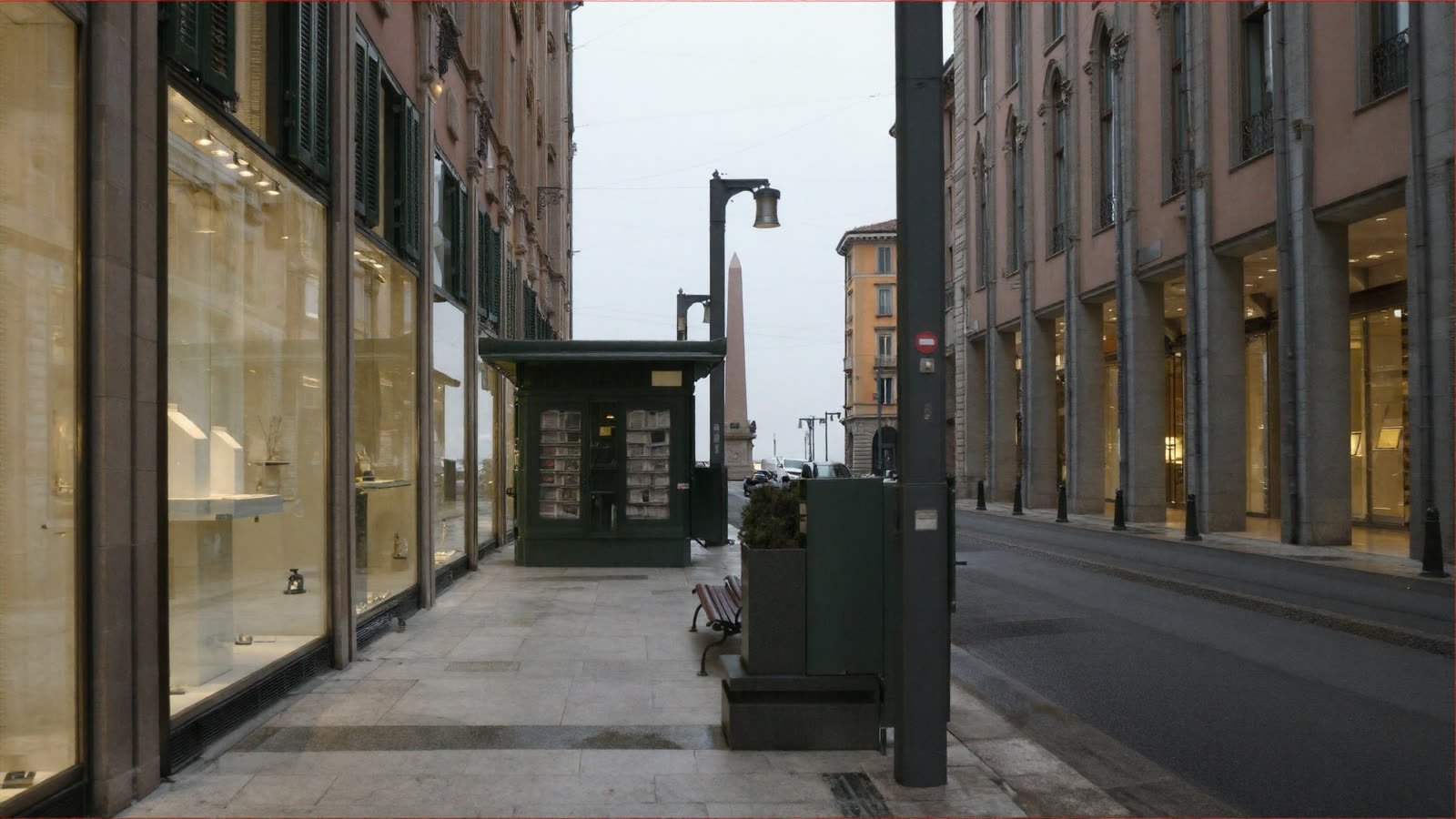
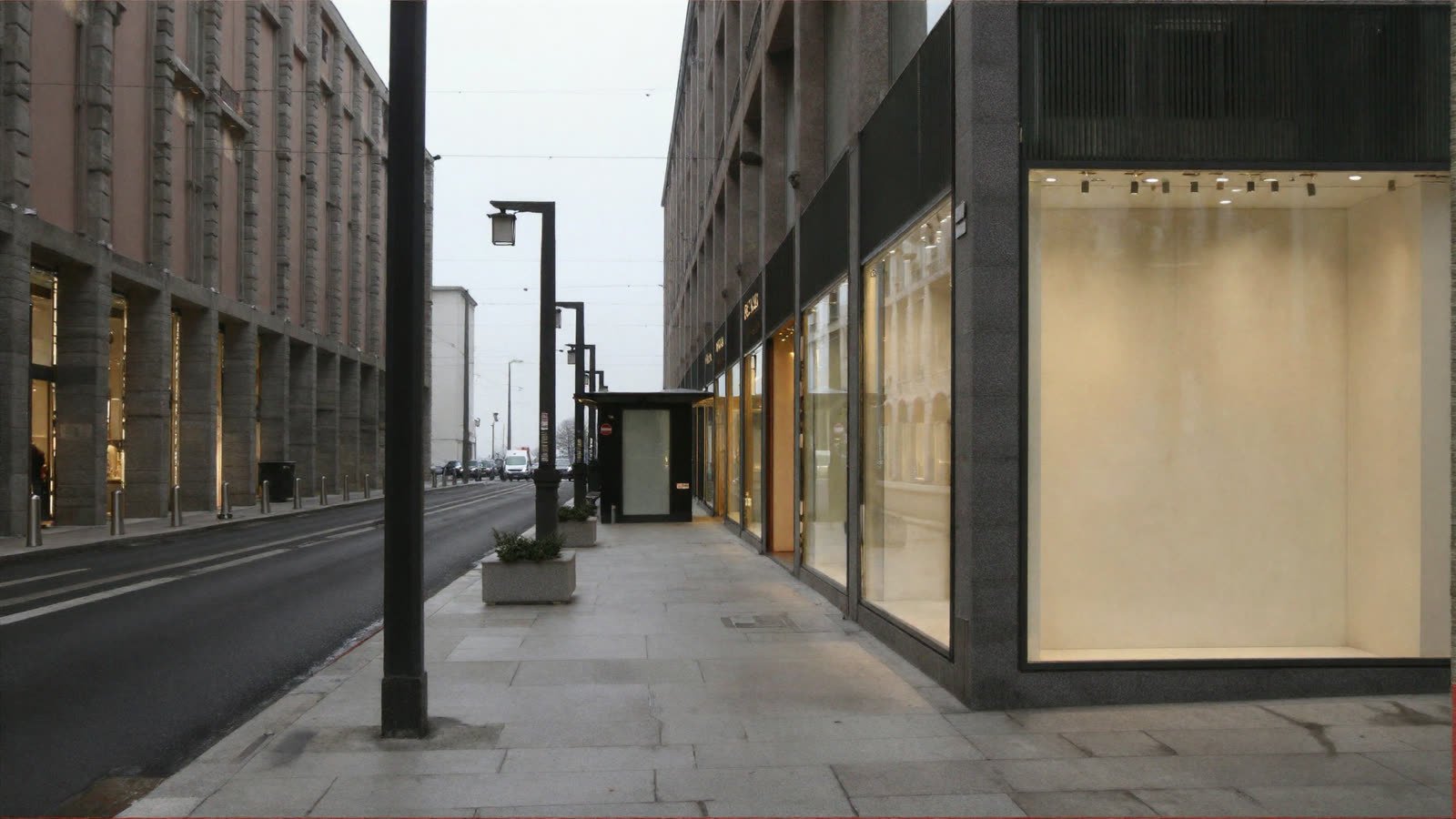
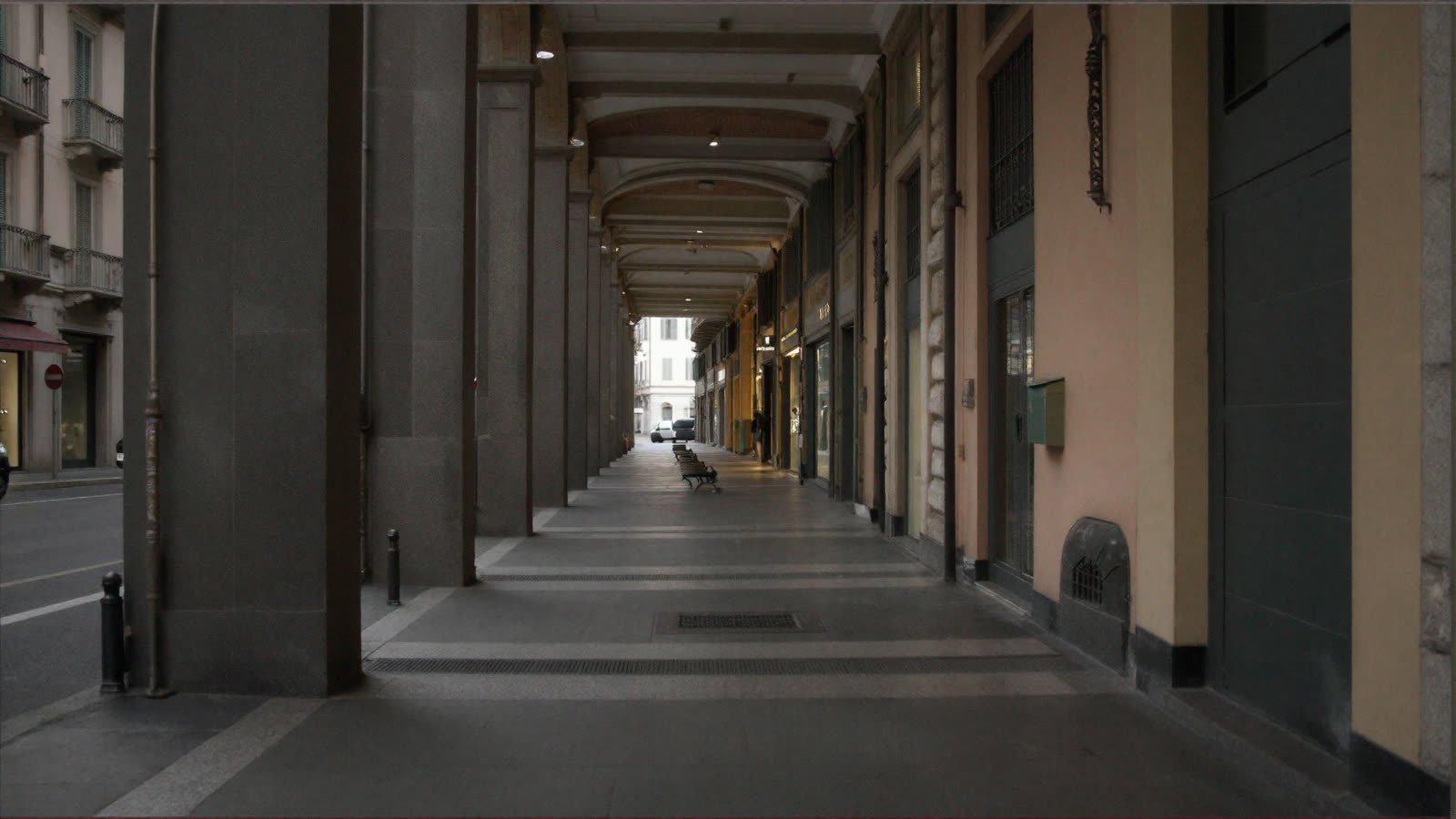
This is the test that was failing on two different sets before. Two cameras stand on the same pavement, facing each other, with a kiosk, four lamp columns, a bench, a planter and both frontages between them. Each gets its own starting picture, rendered from the same three-dimensional model. Neither is generated independently and neither is a reprojection of the other.
And then it was pushed three ways
One good pair proves nothing, so it was run again three ways. It survived all three.
- Three different random starts on each camera. The place holds in all six: the arcade to camera-right in every one of the first camera’s frames and camera-left in every one of the second’s, with the kiosk, lantern, bench and obelisk in the same places. Agreement with the intended layout scores +0.643 and +0.705 against +0.289 for the same camera with no starting picture.
- Six more cameras across the whole set. Four are usable frames. The best of them stands inside the arcade and comes back as a real arcade — a thing that had failed every previous attempt.
- Motion, which is the only test that matters and had never been run. Four seconds, a hundred and twenty-four frames. At the last frame both cameras are still the same street and neither has swapped sides. The two views are closer in colour at the end than at the beginning — 0.188 apart at the first frame, 0.149 at the last.
Your other four questions
- Which would you rather watch? Withdrawn. It was a choice between a well-framed collage and a coherent place with a bad camera, and neither is now on the table.
- Does the reverse read as the same place from the other end? Yes — the frames above. It is the first time, and it is on a street rather than the farm.
- Is it usable without the big wide? Still the weak point, and the cause is now known and is not the method. Three cameras fail, in three different-looking ways, for one reason: the set has no far distance. Two blocks, two circuses and a square of road, and nothing beyond — so looking down the long axis, or out through a gap, or from twelve metres up, the model is shown the edge of the world and fills it with a snowfield, a blank wall, a sea. That is a set-building question and it is yours.
- The sun. Answered by mechanism rather than by taste: the light now comes from the starting picture, so it is a thing we set rather than a thing we hope for.
Honest limits
- ⛔ This was proved on a street, not on your farm. The farm sequence you watched has never been re-shot this way. Everything above transfers in principle and none of it has been demonstrated on that set.
- It buys geometry and nothing else. The colour does not improve at all — 0.146 with the starting picture against 0.143 without. And the architecture is free: three random starts on one camera gave a Baroque palace, plain stucco and modern ashlar on the same block. The street plan is pinned; the style is not.
- It costs about half the fine detail — a texture score of 6.3 to 7.7 against 12.5 to 15.0 for the same shots made without it. That is the largest number in the table and nobody was watching it until this week.
- The photographic grain on the starting picture is measured in pixels, not in metres. At a hundred metres that is film grain and it is what bought the realism. At three metres a single blotch is a metre of wall, so a close shot of plate glass came back as rusticated stone. Unfixed on purpose, because fixing it would change every starting picture in the results above after they were measured.
The question was a false choice, and it took your complaint to expose it.
You said the farm looked like a collage of similar places. I went looking for a better way to share one photograph. The actual answer was that we should never have been asking for a photograph of a place we had already built. Render the set, hand it over, and the camera and the place stop competing.