Checkpoint 4 · Three questions · about three minutes to watch
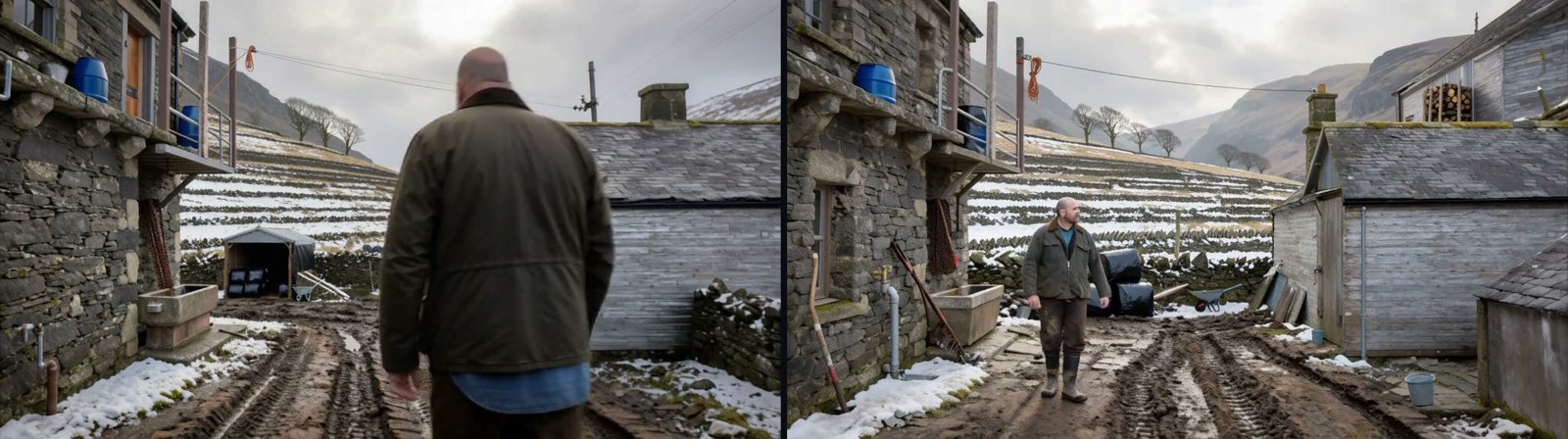
The instruction says: he walks out into the yard, stops in the middle, back three-quarters to camera. Without an end frame, the machine walks him straight up to the lens and parks him there with his back to us — in six shots out of nine, regardless of what the script asks for.
Giving it a second photograph showing where the shot should end fixes that, on the measurements. What I cannot measure is whether the result is staged or merely not wrong.
Three attempts of each, same instruction, same opening photograph, same three random starts. The only difference is whether the machine was also handed a picture of the intended final frame.
no end frameAttempt 1
end frameAttempt 1
no end frameAttempt 2
end frameAttempt 2
no end frameAttempt 3
end frameAttempt 3
One thing to know before you judge it
The end frame does not steer. It cuts.
This surprised me and it is the thing most likely to bother you. The end frame is not a target the shot drifts toward. The clip plays freely for roughly the first half, and then hard-cuts to the supplied end frame and holds it. Measured frame by frame, the change happens across about four frames — a sixth of a second.
So the actor arrives where he was told to arrive, but he gets there by teleporting rather than by walking.
Whether that is usable depends entirely on how visible it is to somebody who is not looking for it — which is exactly the thing I cannot judge, having watched these forty times.
What I need from you
1 · Can you see the cut? Watch a right-hand clip once, straight through, without looking for it. Then watch again knowing it is around the halfway mark. Did you notice it the first time?
What it changes: if it is invisible on a first viewing, this is a usable tool and we build shots around it. If it is obvious, then every shot with an actor in it has a visible glitch at the halfway point, and we need shorter shots that end before the cut lands — which changes how the whole film is planned.
2 · Is the right-hand version actually well staged, or just less wrong? He ends up mid-yard at about two-fifths of frame height with his back three-quarters to us. That is what was asked for. Does it look like a considered shot, or like a man standing in a field?
What it changes: if it is merely less wrong, then blocking is still an open problem and I should stop treating it as solved. There are levers I have not tried; I have not tried them because the measurements said this was fixed.
3 · Is the walking any good? Forget position — look at how he moves. Gait, weight, the mud, whether he looks like he has legs.
What it changes: we have never once assessed motion quality. Every measurement on this project compares still frames. If the movement is bad, that is a category of problem with no instrument at all and it would need one built.
Reply like CP-4: 1 saw it second time only, 2 less wrong, 3 gait is fine mud is not.
Worth knowing: the clips on the left are not a strawman. That is what this project produced by default for its first three weeks of shots with people in them, and nobody noticed the pattern until it was counted — six times out of nine, the same failure, in shots whose scripts all said something different.