Session S-033 · Experiment E-062 · CASCINA CORVARA, camera F8
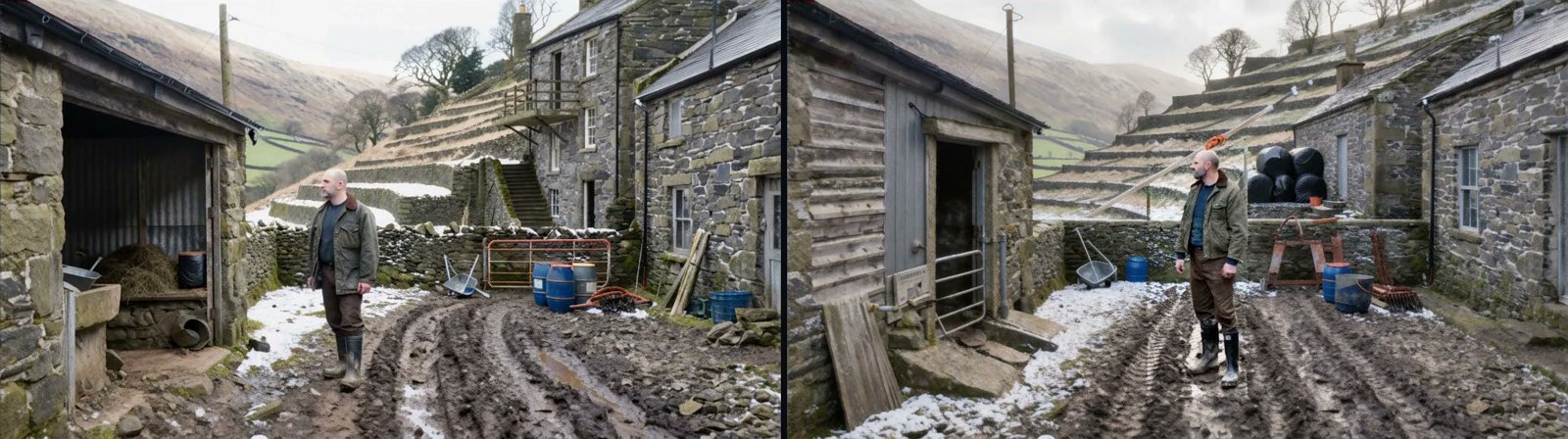
Two shots of the same farmyard, cut together. Same camera, same story, same three random starts. The only difference is how the second shot’s still was made — and that is the whole question.
What to look for. Both versions start on the correct yard. Watch what happens roughly a third of the way through shot 1, when the video model cuts to the end frame it was given. On the left, it cuts into a different farm. On the right, it stays where it was. Then watch the join at the halfway point — where shot 1 becomes shot 2 — and see whether you can find it.
Specific things worth checking on the right-hand version: the barn’s dark doorway, the four black-wrapped bales, the red trestle, the two blue barrels, the wheelbarrow, and the ruts in the mud. They should be the same objects in the same places for the whole nine seconds. One thing genuinely does go missing — the creosoted post the man stands where. That is the cost, and it is discussed at the bottom.
todayShot 2’s still rendered fresh
Same random start, same set drawing, one paragraph added to put a man in the yard.
newShot 2’s still copied from shot 1
Shot 1 handed back to the machine with only the 7.7% the man stands in repainted.
The other two attempts
The same thing twice more, because one is not a measurement
Everything here was rendered three times from three different random starts. The point of showing you all three is that the failure on the left is not bad luck — it happens every time, and it is a different wrong farm each time.
todayAttempt 2
newAttempt 2
todayAttempt 3
newAttempt 3
The numbers behind it
What was measured, and what was missed
The yard, still to still — old way
16.6 dB
The yard, still to still — new way
27.7 dB
Both buildings, start to end of the beat — old
15.8 dB
Both buildings, start to end of the beat — new
23.8 dB
Higher is more similar. The last two are the ones that matter, because they measure the two farm buildings at the start of the first shot against the end of the second — nine seconds and one cut apart. That is the film-maker’s question: are we still in the same place?
Three honest caveats, so you are judging the real thing.
- The join between the two shots came out at 28.9, and I was aiming to beat 31.8. I missed. That older figure came from a different camera and a different pair of stills, so it may never have been a fair target — but it was the target.
- A locked object is gone. There was a creosoted post standing exactly where the man had to stand, and the repainted patch ate it. Every other object on the farm survives; that one does not.
- Copying fixes the still, not the wandering. The video model still drifts across the four and a half seconds of each shot, and it drifts by different amounts each time — attempt 2 on the right is noticeably looser than attempt 3. The floor came up a long way; the wobble did not go away.
These clips have sound — wind, the trough, cattle in the barn, crows across the valley — written into the prompt rather than added afterwards. The players are muted so the pairs stay in step; unmute one on its own to hear it. There is no music anywhere and there is not meant to be.
The write-up this comes from is One instrument turned out never to have existed.